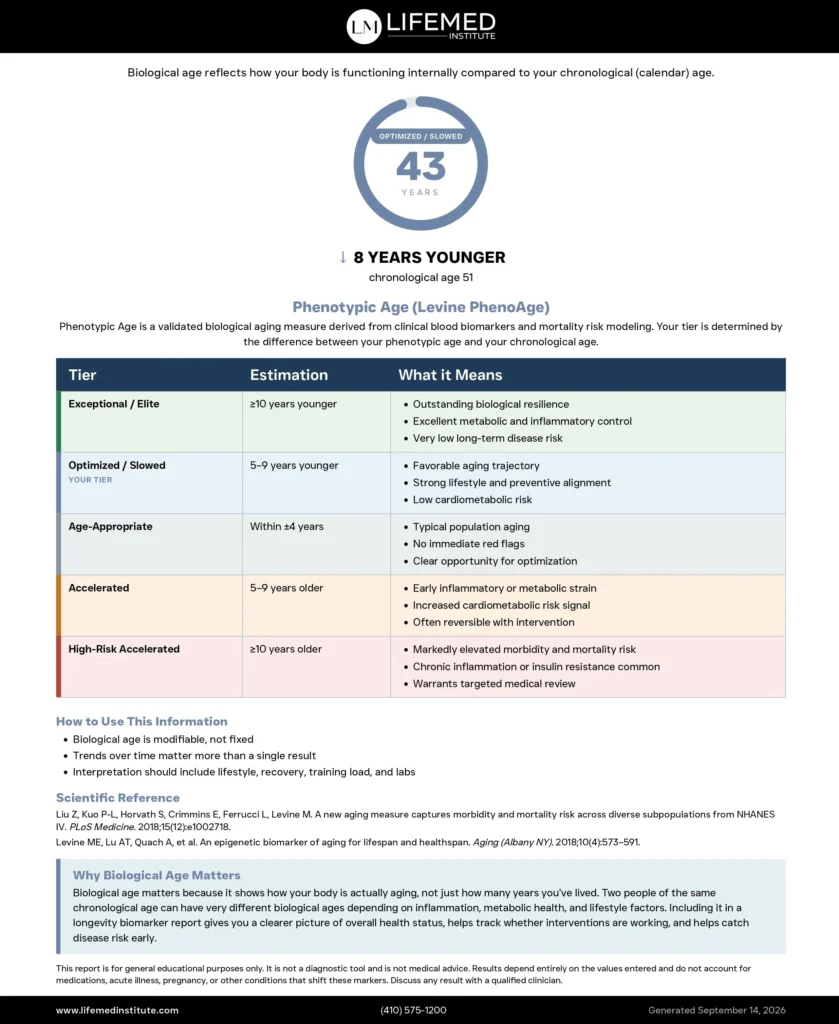
Two people can share the same birthday yet have very different health profiles. One may have healthy metabolic markers and balanced inflammation, while the other shows signs of physiological stress. Chronological age tells us how long someone has lived, but does it tell the whole story? Phenotypic age offers another perspective. By combining chronological age with nine blood biomarkers, this scientific model estimates how your health profile compares with patterns associated with aging.
Phenotypic age, also known as clinical PhenoAge, is a measure of biological aging developed using clinical data and mortality-related risk patterns. It combines chronological age with nine blood biomarkers to generate an age-equivalent estimate.
For example, a 50-year-old with a phenotypic age of 44 has a biomarker profile associated with a younger age in the model. A higher estimate suggests the opposite. Neither result determines your actual lifespan or provides a diagnosis.


Research published in Aging in 2018 by Morgan Levine and colleagues introduced the clinical phenotypic age model. Using data from a large population study, researchers developed an algorithm that combines age and blood measurements to estimate mortality-related risk.
The approach helps researchers investigate why people of the same chronological age may experience different health outcomes. Clinical PhenoAge should not be confused with DNA methylation-based PhenoAge, which uses epigenetic data rather than routine blood biomarkers.

A protein associated with liver function, nutritional status, and inflammation.
A waste product commonly used to assess kidney function.
A measure related to blood sugar regulation and metabolic health.
A marker of inflammation.
Reflects the proportion of lymphocytes among white blood cells.
Measures the average size of red blood cells.
Measures variation in red blood cell size.
An enzyme associated with liver, bile duct, and bone activity.
Provides information about immune-cell levels.
The validated algorithm applies a statistical formula, developed using population health data, to chronological age and the nine biomarker values.
Chronological age + nine blood biomarkers → PhenoAge algorithm → Phenotypic age estimate
Many required measurements are available through routine blood tests. However, accurate calculation depends on using the correct values, units, and validated formula.
Your score provides an estimate, not a definitive judgment about your health.
A higher result may warrant reviewing individual laboratory findings with a healthcare professional. Temporary illness, medications, and existing conditions can influence your measurements.

Because phenotypic age depends partly on measurable blood biomarkers, changes in those markers can affect your score. However, a lower number does not automatically prove that biological aging has slowed. Focus on sustainable habits that support long-term health:
These habits support general health, even when they do not produce a predictable change in your phenotypic age score.